The Empty Frame: How AMC Turned What It Hides From You Into Its Most Powerful Storytelling Tool
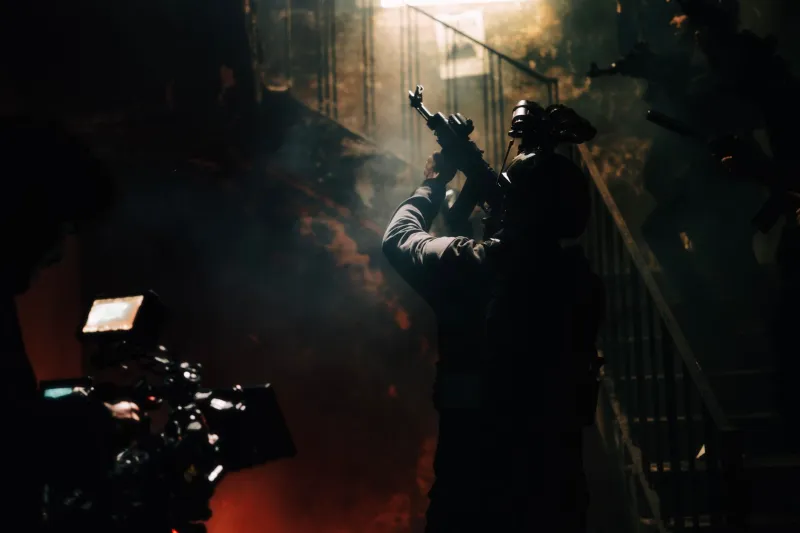
There's a moment in Breaking Bad that lives in the memory more vividly than almost anything that does appear on screen. Walt makes a phone call. A child is in the wrong place. And then the show cuts away. What follows happens somewhere the camera refuses to go — and because of that refusal, it wrecks you completely. You fill in the blank yourself, and your imagination is meaner, more specific, and more personal than any director's interpretation could ever be.
That's not an accident. That's a philosophy.
AMC has quietly built one of the most distinctive visual and narrative languages in prestige television, and a huge part of that language is silence. It's the held breath before a scene ends. It's the conversation that clearly happened but that we arrive too late to witness. It's the reaction shot that the show deliberately withholds. For a network whose reputation was forged on bold, loud, morally combustible storytelling, AMC turns out to be remarkably comfortable with the power of nothing.
Restraint as a Creative Weapon
When we talk about great television, we almost always talk about what's there — the performance, the writing, the production design. But the more you study AMC's best work, the more you notice how often the creative team is making a choice to not show something, and how deliberately that absence is constructed.
Consider Mad Men. Matthew Weiner's series was littered with off-screen events that shaped everything we did see. Don Draper's past existed mostly in negative space — glimpsed in fragments, hinted at in behavior, but rarely laid out in clean, explicit flashback. The show trusted viewers to build a psychological portrait from the gaps. That trust is rare in network television, where the instinct is almost always to over-explain, to underline, to make sure the audience is never confused for a single second.
AMC consistently bet against that instinct. And it kept winning.
The technique works because of something basic about how human beings process stories: we remember what we imagine more vividly than what we're shown. When a show hands you a fully rendered scene, your brain receives it passively. When a show withholds the scene and leaves you the outline, your brain becomes a collaborator. You're no longer watching — you're constructing. The emotional investment goes through the roof.
The Conversation That Never Happened on Camera
Better Call Saul became a masterclass in this approach across six seasons. The show's writers understood that the audience already knew where Jimmy McGill was headed — we'd watched him arrive there in Breaking Bad. So rather than racing toward that destination, Saul lingered in the spaces between. Crucial decisions, arguments that changed relationships forever, moments where a character crossed a line they couldn't uncross — these frequently happened in the gaps between episodes, or off to the side of the frame, or in conversations we heard only secondhand.
Kim Wexler's arc, in particular, was built on what the show didn't show us. Her internal moral collapse happened largely in private. We saw the before and the after. The during was our problem to solve. That structural choice transformed a character who could have been a straightforward tragic figure into someone genuinely haunting — because the version of Kim that existed in your head was assembled from your own fears and projections.
That's a level of psychological intimacy that explicit storytelling almost never achieves.
What the Camera Refuses to Show
There's also a more visceral dimension to AMC's restraint. The network's willingness to cut away at the moment of maximum impact — rather than lingering on it — has produced some of the most memorable scenes in modern television precisely because of what they withhold.
The Walking Dead, for all its reputation as a show that didn't shy away from graphic content, used strategic off-screen violence more effectively than almost any other genre series. The deaths that hit hardest weren't always the ones shown in full. They were the ones where the camera moved to a reaction, or to a closed door, or to the sound design carrying the weight while the frame stayed deliberately empty. The show understood that grief and horror land differently when the audience's nervous system has to do some of the work.
This isn't just an aesthetic preference — it reflects a genuine theory of viewer engagement. When you're forced to imagine something, you can't distance yourself from it the way you can from a rendered image. You can't say "that's just the show." Because the image came from inside your own head.
The Reaction Shot That Isn't There
One of the subtler versions of this technique involves the withheld reaction — the moment when a show gives us the action but not the emotional response, leaving us to hang in uncertainty.
Halt and Catch Fire, one of AMC's most underappreciated series, was built almost entirely on this device. Characters would say something devastating, or make a choice with obvious consequences, and the show would cut before we got to see how the other person absorbed it. That gap — that space between the blow landing and the wound becoming visible — was where the show actually lived. It forced a kind of active spectatorship that made the emotional payoffs, when they finally arrived, feel genuinely earned rather than manufactured.
The restraint also had a cumulative effect. By the time Halt and Catch Fire did give you the full emotional scene — the unguarded confession, the breakdown that had been building for episodes — it meant something enormous. The show had been hoarding those moments, spending them carefully, and the audience felt the weight of every one.
Why This Works for AMC Specifically
It's worth asking why this approach fits AMC's brand so naturally. Part of the answer is the network's early commitment to long-form storytelling — seasons designed as complete narrative arcs rather than episodic procedurals. When you have that kind of runway, you can afford to withhold. You can plant an absence in episode three and let it grow until episode nine. The architecture supports it.
But there's also something about the specific audience AMC cultivated. These are viewers who showed up for Breaking Bad and Mad Men and Better Call Saul — people who actively wanted to do interpretive work, who found the puzzle-solving aspect of prestige drama part of the pleasure. AMC's restraint is, in some ways, a form of respect. It assumes you're paying attention. It assumes you'll remember. It assumes you can handle not being told everything.
That assumption has defined some of the best television of the last two decades.
The Loudest Silence on TV
In a media landscape that increasingly defaults to over-explanation — post-episode podcasts walking you through the symbolism, recap culture that assumes you missed everything — AMC's commitment to meaningful absence feels almost countercultural. The empty frame isn't empty at all. It's full of everything the show chose not to say out loud, trusting you to hear it anyway.
The greatest stories don't just live in what's shown. They live in the space between — in the pause before the cut, the door that stays closed, the conversation you'll spend years imagining. AMC figured that out early, and the television landscape is richer for it.